

Grace in the Garden of God (A Sermon on Luke 23:39-43)
- matthewheisler

- Mar 7, 2023
- 11 min read
Updated: Mar 15, 2025
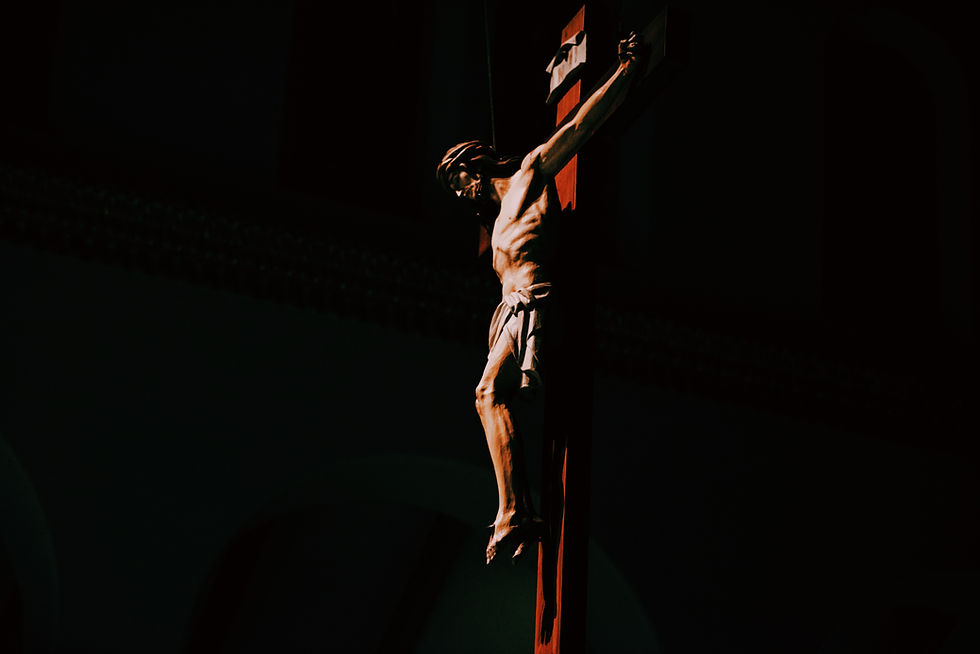
Below is a transcript from Sunday, March 5. It's part of a Lenten series on the "seven last words of Christ." This week's words: "Truly I tell you, today you will be with me in paradise."
This week’s reading comes from Luke, chapter 23, verses 39-43. Friends, hear the Word of the Lord:
Luke 23:39-43
One of the criminals who were hanged there kept deriding him and saying, “Are you not the Messiah? Save yourself and us!” 40 But the other rebuked him, saying, “Do you not fear God, since you are under the same sentence of condemnation? 41 And we indeed have been condemned justly, for we are getting what we deserve for our deeds, but this man has done nothing wrong.” 42 Then he said, “Jesus, remember me when you come in your kingdom.” 43 He replied, “Truly I tell you, today you will be with me in paradise.”
This is the Word of the Lord. Thanks be to God.
At this point in Jesus’ story, he has already gone through an awful lot. He’s faced the betrayal and denial of his disciples, the rejection of the crowds, the conspiring of the religious leaders, and the torture and humiliation at the hands of the Roman soldiers. Now he is being crucified and, right in the middle of his utmost pain, Jesus faces more derision. One of the criminals begins to mock Jesus, “Are you not the Messiah? Save yourself and us!”
Since we know that Jesus was fully human, these words had to have pained his heart, just like the whips of the Roman soldiers had punctured his body. But, just as he was before the Roman ruler Pontius Pilate, Jesus remains silent. He does not defend himself from the attacks on his body or on his identity.
The Second Criminal
It’s an unlikely person, the second criminal who does that. In fact, the second criminal is the only one in this whole crowd of people to recognize Jesus as the true King he is! He says, “Jesus, remember me when you come in your kingdom.” He sees Jesus’ bruised and battered body, and does not see this as Jesus’ defeat, but the start of Jesus’ reign. This criminal sees somehow that Jesus will reign and, though all hope seems to be gone for him, he longs just to be remembered in Jesus’ coming rule. It is through his eyes, the eyes of a criminal, that Luke invites us to see Jesus and the cross.
It’s not that Luke wants us to think of the criminal as a “good guy.” This is not a misunderstood do-gooder who mistakenly found himself on a cross at Golgotha. No, in his own words, this criminal deserves this terrible punishment. We don’t know exactly what he had done - Matthew’s Gospel calls him a robber, but Luke uses the more general term kakourgos, which means evildoer or criminal. We do know that he had done some awful things - scholars take guesses ranging from armed robbery to even murder. Yet, out of all of the people who were revered and respected in Jesus’ culture, it’s this guy who sees Jesus truly. And, Jesus sees him, too.
Amazingly, Jesus’ response is bursting at the seams, overflowing with loving grace towards this man. In the midst of all of Jesus’ agony and pain, he responds with instant and abundant grace: “Truly I tell you, today you will be with me in Paradise.”
We may scratch our heads and ask, what makes sense about this grace? Why would Jesus bestow such a great honor on such an honorless person? But, that’s what makes grace so amazing, isn’t it? It’s completely undeserved, it’s more than we could ask for, and it cannot be purchased, controlled, or fit into an easy box. And, Jesus understood and divvied out grace so well, didn’t he? This is exactly why so many tax collectors, sinners, and other outsiders flocked to him. They craved what only he could give. It’s also the reason the early church was full of women, slaves, and other people society didn’t give two poops about. They had caught sight of the beautiful grace of God and they were divvying it out like mashed potatoes on Thanksgiving.
Ambrose of Milan, a great saint from the 4th century, writes this about Jesus’ response: Jesus’ “pardon is given so readily, so abundantly to the criminal; and grace far exceeds the prayer. The Lord always gives more than we ask…” Friends, do we realize that God is always giving more than we could ask, more than we could even dream? I know that it is so hard to sense sometimes - my understanding of God’s grace can be clouded by my own resentments, my pain, and my own sense of who deserves what. But God’s economy is often so different from our own, and, honestly, at the end of the day, God’s economy is the only one that really matters.
God’s grace is so surprising, oftentimes arriving when we least expect it. This is partly because God himself is often where we least expect him. Jesus’ contemporaries certainly did not think God would be nailed to a cross. They didn’t think God would be dining with sinners or turning water into wine. They didn’t think that he would have harsh words for the religious elite and gentle ones for the riff raff. God’s grace is unexpected and it often happens upon the most unusual people. This truth reminds me of a little character from an old fantasy book. Maybe you’ve heard of him? He goes by the funny name of Bilbo Baggins and he’s a Hobbit.
Hobbits in the Lord of the Rings series are very unusual people. They’re short, with furry little feet. They’re reclusive and strange, and make their homes in Hobbit-holes, little houses built into hills. They’re curmudgeonly and unfriendly to new people and new experiences, and yet, in the epic Lord of the Rings stories, they end up smack dab in the middle of a grand adventure, and they end up playing a crucial role in saving the world. Little did they know they would go from their quiet Hobbit-holes eating cheese and drinking tea to fighting orcs and goblins, scaling the fiery Mount Doom, and throwing the treacherous One Ring into its depths. I’m sure, little did this criminal know that he would end up next to the Messiah and, what’s more, that this Messiah would promise him a place in his kingdom, a spot in the grand adventure and story of God.
Just like Bilbo didn’t know what he was getting himself into when he cracked the door to that grand old wizard Gandalf, those early, lowly Christians didn’t know that when they were encountered by the grace of God, they were also welcomed into the grand adventure that is the Christian life. This is where we dig into what is meant by 1) “God’s kingdom” and 2) that funny word “Paradise” in our scripture today.
Kingdom of God
Basileia is the Greek word for kingdom through much of the New Testament and it’s the word used here by the criminal in his request to Jesus. It’s a multifaceted word, which can mean the physical location of a kingdom, like the United Kingdom. But, it can also refer to a king’s reign and the more abstract idea of the reach of a king’s power. In the Gospel of Luke and its biblical sequel, the Book of Acts, the kingdom of God is described as “the upside down kingdom.” In Acts 17, a group of Christians are arrested in Thessalonica and brought before the city authorities. Here are the charges that are brought against them:
“These people who have been turning the world upside down have come here also, and Jason (one of the Christians) has entertained them as guests. They are all acting contrary to the decrees of the emperor, saying that there is another king named Jesus.”
Did you catch it? These Christians are turning the world upside down. And, they’re disobeying Caesar because there’s another king - King Jesus! If we pay attention to Jesus, this should make perfect sense, because, earlier in the story, at the beginning of Jesus’ ministry in Luke 4, he gives a big announcement about what he’s all about:
“When Jesus came to Nazareth, where he had been brought up, he went to the synagogue on the Sabbath day, as was his custom. He stood up to read, and the scroll of the prophet Isaiah was given to him. He unrolled the scroll and found the place where it is written: ‘The Spirit of the Lord is upon me, because he has anointed me to bring good news to the poor. He has sent me to proclaim release to the captives and recovery of sight to the blind, to set free those who are oppressed, to proclaim the year of the Lord’s favor.’”
This is like Jesus’ inaugural address. This speech is at the beginning of his ministry and announces what types of policies, practices, and even people will be the norm in his kingdom. The folks who typically got bad news? In God’s kingdom, good news is here! The forgotten about? Not only are they invited, but they’re welcomed in and given the very best!
And, the kingdom of God gets us into trouble sometimes, because the systems of the world are so often set in opposition to it. This is why, immediately after Jesus delivers his address, the people get furious and try to throw him off a cliff. It’s why the Christians in Thessalonica were arrested and accused. So often, we can associate God’s way with a quiet church building, a beautiful sanctuary, times of personal devotion and prayer, and the comfortable folding of hands. And, those things are certainly true, but following God also leads to some great adventures! It’s no accident that the civil rights movement in the United States was largely fueled by churchgoers, those who had caught visions of the kingdom of God. They couldn’t stop their feet from marching against injustice because the grace of God had so transformed their hearts and lives. It’s no accident that we here at Lake Grove continue to engage in local missional work with organizations like Family Promise, Refugee Care Collective, Woodburn Ministries, Salvation Army, and others. It’s no accident that Lake Grove members are in Jordan and Israel right now. Encountering the grace of God, being brought into the Kingdom of God, sends us places we might never have imagined.
You see, the Kingdom of God is the home of grace, which always changes our way of being in the world - it’s the place where the unimaginably good happens to those the world says don’t deserve it, and when it happens, we can’t help but be propelled into a different way of life as a result. It’s where a criminal asks to be remembered at some point in the future, and instead he is welcomed into Paradise today.

Paradeisos
This word for Paradise is packed with more meaning than we might see at first glance. Paradeisos is used only 3 times in the New Testament. Once in today’s scripture in Luke 23. It comes up again in 2 Corinthians 12:4, where Paul describes his experience of being “caught up into paradise (paradeisos)” and has a kind of mystical experience of hearing “unspeakable words.” And, finally, it’s in Revelation 2:7, where it is promised that those who listen to the Spirit’s message will be able to eat of the tree of life, which is in the paradise (paradeisos) of God.”
In the Septuagint, the Greek translation of the Old Testament, paradeisos shows up at least 26 times. The vast majority of them are in the book of Genesis, in the account of Creation:
Genesis 2:8-9, 15-17:
8 And the Lord God planted a garden (paradeisos) in Eden, in the east, and there he put the man whom he had formed. 9 Out of the ground the Lord God made to grow every tree that is pleasant to the sight and good for food, the tree of life also in the midst of the garden (paradeisos), and the tree of the knowledge of good and evil.
15 The Lord God took the man and put him in the garden (paradeisos) of Eden to till it and keep it. 16 And the Lord God commanded the man, “You may freely eat of every tree of the garden (paradeisos), 17 but of the tree of the knowledge of good and evil you shall not eat, for in the day that you eat of it you shall die.”
Well, we know what ends up happening in the Garden, don’t we? Adam and Eve eat from the tree and the great break of relationship begins - they are soon hiding from God, their offspring betray and kill each other, and the whole history of humanity’s struggle to be in right relationship with God, each other, and even with ourselves begins.
Yet, at the cross, God’s rescue story hits a climax. It’s no mistake that though the criminal asked to be remembered in the kingdom, Jesus did not simply respond that yes, you’ll be in the basileia with me. Instead, Jesus says paradeisos. Why? Because, at the most unlikely event, the horror and hell of the cross at Golgotha, humanity is being brought back to the Garden. In the exchange with the criminal, Jesus is telling him and us that he has made a way to go back to the Garden. To enjoy the beauty of creation and the wonder of being in good and true relationship with each other, with ourselves, and with God. To have a purpose in helping tend to God’s creation, to be able to share our vulnerabilities, our flaws, hurts, and burdens, with one another and with God. There’s no need for pretense. Grace has made a way.
And, friends, if God can do such a thing in the dark and terrible scene of the cross, can you imagine what gardens of grace he might be inviting us into in the midst of our own brokenness, pain, and trauma? The smugness of an enemy can not stop such grace. The jeering of mocking crowds or inner critics can not stop such grace. The ugliness of whatever sin you have in your past, present, or future can not stop such grace. No empire with its torture devices and twisted ideas of justice can stop such grace. Whatever wrong has been done to you and whatever wrong you’ve done can not stop such grace.
Truly, nothing can overcome this grace, but instead, this grace overcomes everything. It’s as the Apostle Paul writes in Romans 8, “in all these things we are more than victorious through him who loved us…neither death, nor life, nor angels, nor rulers, nor things present, nor things to come, nor powers, nor height, nor depth, nor anything else in all creation will be able to separate us from the love of God in Christ Jesus our Lord.” The love of God has been shown to us at the cross - it’s seen in the bruised and battered body of Jesus, it’s seen in the invitation he extends to the criminal and to us.
Jesus’ victory of grace brings us from whatever hell we find ourselves in to the unbelievably good Garden of God. It’s what our hearts long for, it’s what every good thing is just a hint of. And, the invitation is extended to us. No one is disqualified. The criminal hanging on the cross is our proof of that - no matter what you’ve done, no matter what shame you carry, the invitation of God’s grace is here for you. And, friends, I’ve found that I have to come back to the grace of God time and time again. Maybe you can relate. The writer of the famous hymn “Come, Thou Fount of Every Blessing,” seemed to get it. He captures our dependence on grace beautifully in his 3rd verse:
“O to grace how great a debtor daily I’m constrained to be!
Let that grace now, like a fetter, bind my wandering heart to thee.
Prone to wander, Lord, I feel it, prone to leave the God I love;
Here’s my heart; O take and seal it; seal it for thy court’s above.”
Friends, my prayer is that amidst every transition and disruption, every hardship and burden, every sin and guilt and shame, you would know that God holds you in grace, and the invitation to the Garden of God’s Grace is there. It doesn’t depend on your goodness, your abilities, your accomplishments, or anything else - it’s the way that Jesus has opened by his great love for us. In the midst of whatever hell you’re facing, God’s grace can find you there. Amen.
Benediction
Friends, may you know the fullness of God’s grace. May you answer the invitation to the Garden of God. May you learn to walk with God closer over the years. May you know that you are so deeply loved by the One who made a way for you. Amen.

Comments